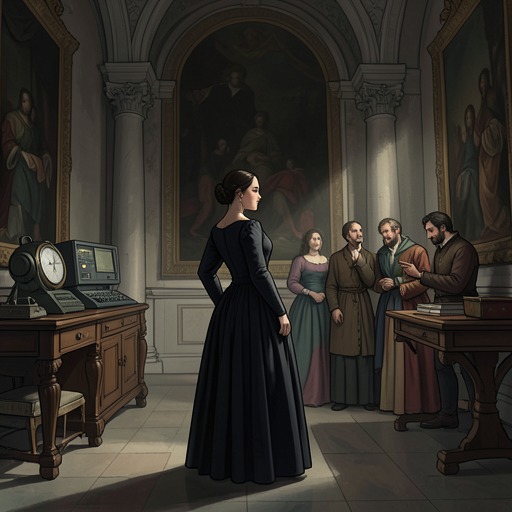
Princess Sherbatoff’s social isolation
In Search of Lost TimePrincess Sherbatoff’s social isolation shapes her place in the Verdurin circle: estranged from her family and ostracised elsewhere, she becomes the rare member whose loyalty does not lapse, while the fiction of chosen solitude helps conceal how little society she can enter. Her position exposes the difference between belonging freely and making a refuge of the few doors left open.
Isolation and the Verdurins
For years, the Grand Duchess Eudoxie allowed the Princess to visit only in the early morning, when none of the Grand Duchess’s other friends were present. The arrangement kept the Princess apart from a wider social gathering, protecting those friends from an encounter that would have been disagreeable to them and awkward for her. After leaving the Grand Duchess, the Princess went to Madame Verdurin, who had only just risen, and remained with her for the rest of the day. This routine gave the Princess continuity, but it also registered the narrowness of the social world available to her.
The Princess’s exclusion made her unusually dependable to the Verdurins. Other members of the circle, however devoted, might travel, fall ill, attend to a dying parent, or be drawn away by some other obligation. Madame Verdurin had repeatedly insisted that her circle should take precedence over family and other claims, yet could not prevent such defections. The Princess, whose family ties had been severed and whose access to other houses was limited, became an exceptional instance of the constancy Madame Verdurin had long wanted from her followers. Her fidelity was not simply a matter of temperament: it grew from the absence of alternative attachments and social invitations.
A refuge made into a family
The Princess was estranged from her family and an exile from her native land. Apart from the Verdurins, her named connections included the Baroness Putbus and the Grand Duchess Eudoxie, but her visits to the Grand Duchess took place under the restrictive early-morning arrangement. The Verdurins’ household therefore became more than one appointment among several. When Madame Verdurin, fearing she would be left alone on New Year’s Eve, asked whether the Princess would stay the night, the Princess answered that she could do so on any day of the year and described Madame Verdurin as her family. She lived in a boarding-house, moved when the Verdurins moved, and accompanied them on their holidays.
Madame Verdurin sought to make this attachment survive even death: she obtained the Princess’s promise that whichever of them died first would be buried beside the other. The promise turns social loyalty into a bond imagined as lasting beyond the circle’s ordinary routines. The Princess’s isolation thus gives the Verdurins a kind of intimate centrality in her life, while the burial pledge makes that centrality explicit and permanent in prospect.
The performance of chosen solitude
Before outsiders—including herself, the narrator observes—the Princess represented her three friendships as chosen above all others, rather than as the few relationships left after circumstances had destroyed the rest. She said that she saw nobody else and visited only three houses, presenting limitation as a rule she had imposed on herself. The distinction mattered: chosen solitude could appear to express taste and independence, while exclusion would reveal dependence on other people’s acceptance.
The Verdurins helped sustain this account among the circle. Its members imagined that the Princess had selected their house from among countless invitations, just as they imagined the Verdurins had made a single exception for an unusually intelligent aristocrat. In this shared construction, each side could treat the other as specially chosen. The story of selectiveness gave a social shape to an attachment that had grown under conditions of isolation, without erasing the difference between the Princess’s restricted access and the Verdurins’ power to define the circle.
Public visibility and private exclusion
The Princess’s position was especially visible at the theatre. Though rich enough to reserve a large ground-floor box for each first night, she used it for the Verdurin faithful and no one else. The party occupied the least prominent box, sat toward the back, and withdrew together shortly before the performance ended. Her apparent indifference to the rest of the audience reinforced the impression that she lived exclusively for the small group.
That theatrical arrangement did not mean she was content with isolation. The narrator explains that the Princess remained in the shadows in an effort to forget the living social world she passionately desired but could not know. Her reserve could therefore be read in two ways: as a performance of disdain for society and as a means of enduring distance from it. The contrast between a costly box and its discreet position makes the arrangement particularly telling: resources could purchase a place in the theatre, but did not by themselves undo the Princess’s exclusion from wider social life.
New acquaintances and the limits of the role
The Princess’s cultivated appearance of coldness became difficult to maintain when a new acquaintance was made. With Madame Verdurin’s or Cottard’s support, a few newcomers managed to meet her; her excitement at such encounters could then carry her so far in trying to please them that the faithful wondered why she had made an exception for someone apparently unimportant. These rare moments reveal the strain within her social role: she was supposed to be inaccessible, yet she welcomed the very contact that her chosen-isolation story denied her.
Her social isolation is thus not merely a personal circumstance but a structure of visibility, access, and dependence. At the Grand Duchess’s house, separation was enforced by the timing of visits; at the Verdurins’, restricted circumstances were recast as exceptional loyalty; in public, a carefully modest theatrical presence helped preserve the appearance of deliberate withdrawal. The Princess’s attachment to the Verdurins offered real companionship, but its intensity also testified to the scarcity of other places where she could belong.